

Documentation Index
Fetch the complete documentation index at: https://domoinc-openapi-sync-documents.mintlify.app/llms.txt
Use this file to discover all available pages before exploring further.
Intro
A nested bar with line chart is a combination of a Chart Properties ). The line and gray total bars are measured on the left vertical axis, and the colored series bars are measured on the right axis.Powering nested bar with line charts
Nested bar with line charts require three columns or rows of data from your DataSet—one for series, one for categories, and one for values. For information about value, category, and series data, see Understanding Chart Data. In the Analyzer, you choose the columns containing the data for your nested bar with line chart. For more information about choosing data columns, see Applying DataSet Columns to Your Chart. For more information about formatting charts in the Analyzer, see KPI Card Building Part 2: The Analyzer. The following graphic shows you how data from a typical column-based spreadsheet is converted into a nested bar with line chart: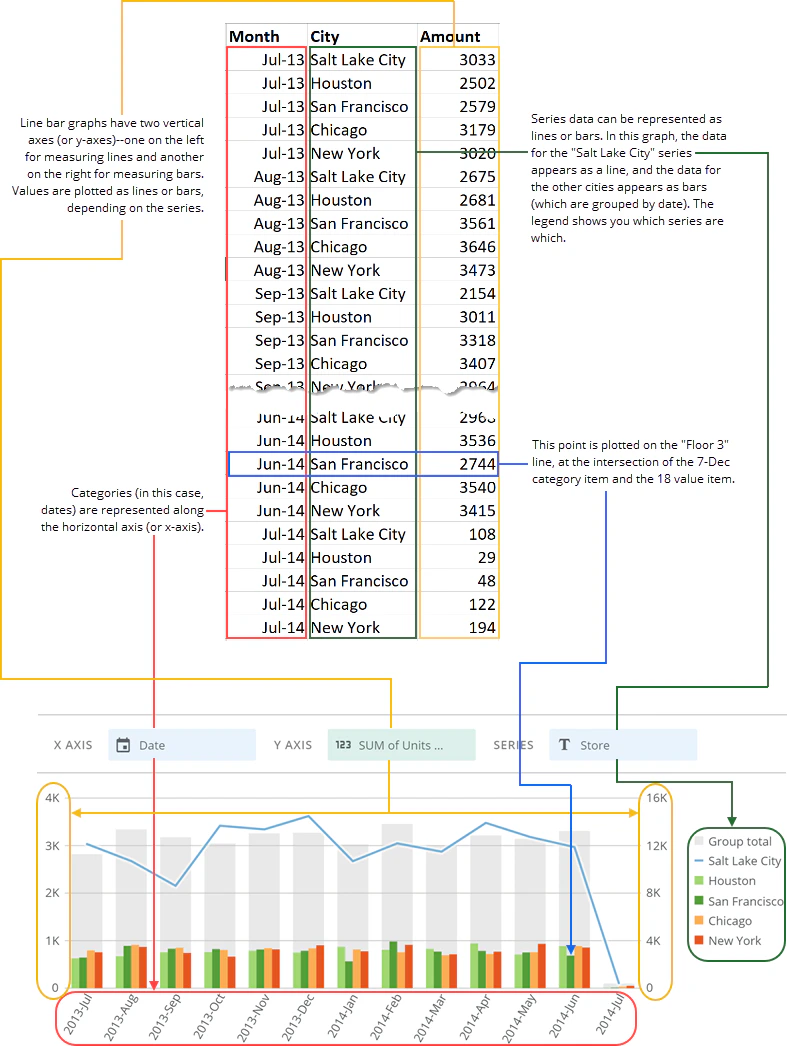
Customizing nested bar with line charts
You can customize the appearance of a nested bar with line chart by editing its Chart Properties and by changing the sorting, scale syncing, and number formatting.Chart Properties
Unique Chart Properties of nested bar with line charts include the following. You can click a thumbnail image to see a larger image. For information about all Chart Properties, see Chart Properties.Property | Description | Example |
|---|---|---|
General > Series on Left Scale | Determines how many series in your chart appear as lines. By default, the first series that appears in your legend for these chart types becomes a line, and all remaining series become bars. However, you can convert series from bars to lines by entering the desired number of lines here. For example, if your chart had three series, the first series appearing in your legend would appear as a line, and the remaining two series would appear as bars. You could turn the second series into a line by entering | — |
| General > Sort Each Category | Allows you to sort the items in each individual category in most kinds of multi-series bar and lollipop charts. You can choose an ascending or descending sort. If you select Default , the default sort is applied. This option does not work when the Value Scale > Log Scale box is checked. In the example at right, bars within all categories are sorted in descending order. |  |
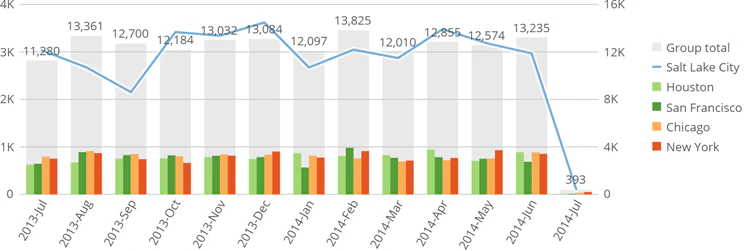
Data Label Settings > Show Group Total | Determines whether data labels appear over the gray “total” bars in nested bar charts. The chart at right shows an example of this. |
|
Sorting
You can manipulate which series becomes lines and bars in a nested bar with line chart by changing the series order in your legend. By default, the sort method is set to No Sorting, which arranges your series in alphabetical order. For most charts with both lines and bars, this is not the optimal sort method. For the best results, do the following:- Ensure that the series that should correspond to the line appears first in your DataSet
- Choose an item-based sorting method, either ascending or descending